The Galileo G1 Quasi-Pilot upgrade was completed on 28/04/2026.
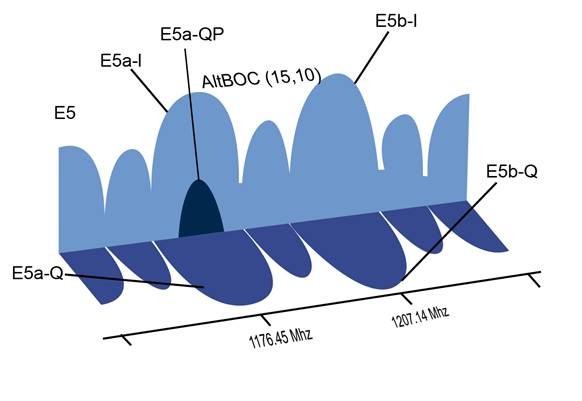
Signals transmitted by Galileo satellites in E5 band, when including the G1 E5 QP
As announced in the GENERAL NAGU #2025060 and #2026029, 12 Galileo satellites have been reconfigured with the Galileo G1 E5 Quasi-Pilot. The list of satellites and the start date of the Quasi-Pilot signal component transmission is available here.
The new Quasi-Pilot signal component enables single-frequency E5 acquisition and improves the service performance. Specifically, it is designed to provide the following advantages:
Low complexity acquisition, typically reduced by a factor of 8, compared to other E5 components, particularly adapted for receivers requiring lower power consumption.
Faster acquisition time, improved typically by factor 3.
Flexible exploitation of the signal features, allowing receivers to exploit the Quasi-Pilot signal component if desired.
The reduced complexity of the E5 Quasi-Pilot signal comes from the use of a smaller code length and the lower chip rate compared to the legacy components of E5. Shorter codes decrease the number of hypotheses that must be assessed during acquisition, thus speeding up the process, while a lower chip rate reduces the memory needed to store the sampled input signals. The technical details about the signal are provided in the updated Galileo OS SIS ICD.
The E5a-QP, described in the Galileo OS SIS ICD, will not be transmitted by G2G satellites, being superseded by the new QP signals defined in the “Galileo Second Generation Evolution of Quasi-Pilot Signals and Interface Control Information” document. This means that the functionalities and availability of G1 E5 QP signal component will be progressively substituted by the G2 QP signal components, with the launch of G2G satellites and the gradual replacement of current Galileo FOC satellites.
The typical availability of the G1 E5 QP signals experienced by the users will be included in the next release of the OS Service Definition Document.
About Galileo
Galileo, the EU´s Global Navigation Satellite System (GNSS), provides improved navigation, positioning and timing information. More than 4 billion users are already benefitting from Galileo.
The Galileo Programme is owned by the EU. The European Commission, as the Programme Manager, oversees the implementation of all activities. EUSPA is responsible for the operational management of the services, ensuring that they are delivered with the defined performance and without interruption. Galileo's system design and system evolution are entrusted by EUSPA to ESA.
Media note: This feature can be republished without charge provided the European Union Agency for the Space Programme (EUSPA) is acknowledged as the source at the top or the bottom of the story. You must request permission before you use any of the photographs on the site. If you republish, we would be grateful if you could link back to the EUSPA website (https://www.euspa.europa.eu).