The Galileo High Accuracy Service (HAS) takes a new step forward to support users in developing and testing its implementation with the release of the HAS User Reference Algorithm, along with datasets and documentation.
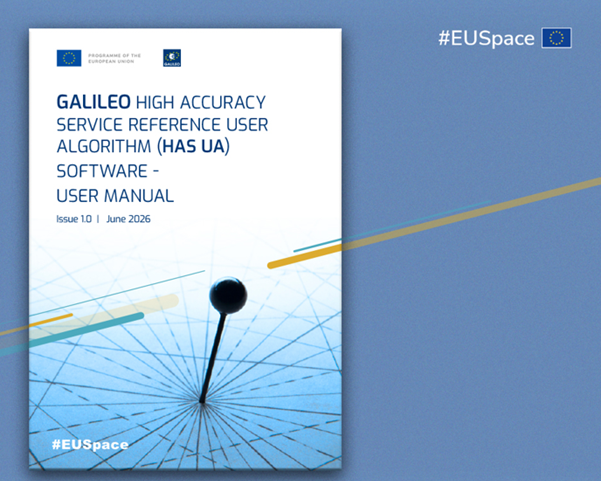
Following the publication of the Galileo HAS Reference User Algorithm Technical Note in December 2025, the Galileo HAS Reference User Algorithm SW, its User Manual and a full set of test data are now available. This will support the implementation of Galileo HAS corrections and the development of applications – whether you use Internet Data Distribution (IDD) or E6B Signal-in-Space (SiS).
Thanks to the HAS User Reference Algorithm SW, users will be able to apply Galileo HAS corrections and obtain a Position, Velocity and Time (PVT) solution, based on Precise Point Positioning (PPP), with HAS Minimum Performance Levels.
The released package includes:
HAS Reference User Algorithm SW User Manual providing step-by-step instructions on installing and configuring the software.
- Matlab source code of the HAS User Reference Algorithm.
Test datasets, including both input and output vectors, to validate your own software implementation.
To access the Matlab source code and associated datasets, register and request access here.
About Galileo
Galileo, the EU´s Global Navigation Satellite System (GNSS), provides improved navigation, positioning and timing information. More than 4.5 billion users are already benefitting from Galileo.
The Galileo Programme is owned by the EU. The European Commission, as the Programme Manager, oversees the implementation of all activities. EUSPA is responsible for the operational management of the services, ensuring that they are delivered with the defined performance and without interruption. Galileo's system design and system evolution are entrusted by EUSPA to ESA.
Media note: This feature can be republished without charge provided the European Union Agency for the Space Programme (EUSPA) is acknowledged as the source at the top or the bottom of the story. You must request permission before you use any of the photographs on the site. If you republish, we would be grateful if you could link back to the EUSPA website (https://www.euspa.europa.eu).