The INTERGEO conference and trade fair took place in Essen from 7 – 10 October. This leading event for geodesy, geoinformation and land management demonstrated the vibrancy and importance of the sector in which satellite-based positioning technologies, such as EGNOS or Galileo, plays a key enabling role.
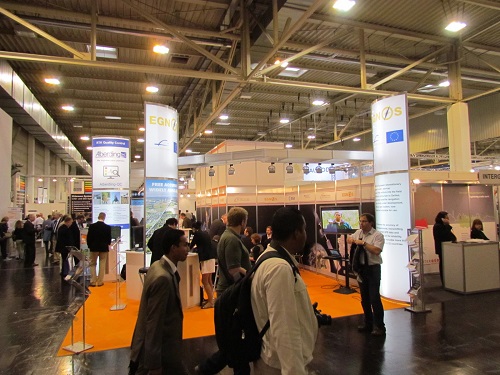
 With 28 000 square metres of exhibition space over three halls of the Essen Exhibition grounds, the 19th edition of INTERGEO showed why it is viewed as the leading European event for the geoinformation sector. In total some 505 exhibitors from 30 countries covered the breadth of products and services required for modern surveying incorporating the latest geodata, information systems and data integration techniques. Satellite-based positioning is now an integral part of these technologies enabling continuing innovation and building new markets.
The organisers anticipated some 16 000 visitors to the exhibition and the three halls were thronging with people giving an overall impression of a sector looking to expand and in vigorous good health.
The audience for the exhibition is becoming younger and more international At a press conference on 9 October Prof Karl-Friedrich Thöne, President of the German Society for Geodesy, Geoinformation and Land Management (DVW eV.), the host for the event in Essen, pointed out another crucial aspect of the show: “INTERGEO is the biggest job fair for our industry. The event is a great platform for young talent: a career platform and a development platform.”
GSA position
The European GNSS Agency (GSA) was, of course, at INTERGEO. Reinhard Blasi of GSA explained the agency’s objectives for the exhibition.
“Already today EGNOS is growing the use of GNSS in real time mapping solutions by providing free accuracy that is widely available. It is a pleasure to notice how EGNOS has made its way into literally all devices and is providing value for Mapping applications on a daily basis” he said. “Getting ready for Galileo to fully take off, we talk about the chip sets and its use within receivers and ensure that they are ready for Galileo services when they start next year. It is important to be here – on the ground and in the market place - making sure that a dialogue is continued with suppliers. In many ways it is all about bringing Galileo down to Earth.”
Jürgen Kliem, Vice President of Trimble Navigation Ltd, one of the leading global suppliers of geospatial and positioning solutions, commented. “All Trimble devices use GNSS. We are very much looking at multi-constellation devices and are part of Galileo developments,” he said. “We are close to Galileo and the introduction of the service is important and will be highly complementary.” He foresaw numerous applications – in particular in solutions for unmanned vehicles.
Demonstrating the imminent start-up of Galileo services was the presence of the European GNSS Service Centre (GSC) precursor, called the “GSC Nucleus”.
 The GSC Nucleus was established in Madrid and is set to be an integral part of the European GNSS infrastructure, providing the main interface for users of the Galileo Open Service and Commercial Service. The GSA is responsible for the management of the GSC.
Alejandra Martinez Cuezva of the GSC Nucleus explained its main roles. “At the moment we are handling queries from around the world on, for example, multi-constellation receivers and generally giving advice to users who are currently using signals from the four already available Galileo satellites,” she said. “We provide basic services to the Galileo user community via a web portal which is conceived as a one-stop-shop for the Galileo users, and a dedicated user helpdesk. The web portal also includes information on the status and availability of the system.”
As the Galileo Early Services come online during 2014 the GSC Nucleus will be upgraded with additional content and web functionality. In the longer-term GSC will be the single interface for providers and users of the Galileo Open Service and later also the Commercial Service.
SAT NAV-Forum
The GSA stand at INTERGEO was shared with the European Space Agency (ESA) and coordinated by SAT NAV Forum, the national network of regional GNSS initiatives, test environments and innovation clusters funded by the German government.
Ulrich Reinfried of the German Federal Ministry of Transport, Building and Urban Development described the forum. Satellite Navigation is all about innovation in navigation applications including GNSS services.”
He sees a strong trend in the market to seamless navigation applications, but also a huge diversity of applications, opportunities and solutions. One of the roles of the SAT NAV-Forum is to use their understanding of the market to enable existing applications to find new markets or industrial sectors.
The SAT NAV-Forum is an important partner for GSA. “The GSA needs multipliers and organisations that can spread the word on opportunities for EGNOS and Galileo at national level,” explains Reinhard Blasi. “To engage with SMEs you need these active organisations at national or regional level to build a viable, diverse community.”
Tim Deimel of the European Space Agency’s Business Incubation Centre (BIC) at Darmstadt was also enthusiastic about the success of innovative start up businesses in this GNSS sector. “Of the 40 businesses that we have looked after in the Darmstadt BIC since 2006, 39 are still in business,” he claimed. “And this has generated some 120 jobs.”
Clearly the geographic information sector is a market with great opportunities and, judging by the crowds at INTERGEO, one that has growing popularity and is attracting innovative European entrepreneurs. It is a sector where positioning is a key enabling technology and Galileo will make a very positive impact.
Media note: This feature can be republished without charge provided the European GNSS Agency (GSA) is acknowledged as the source at the top or the bottom of the story. You must request permission before you use any of the photographs on the site. If you republish, we would be grateful if you could link back to the GSA website (http://www.gsa.europa.eu).
More information: